
International trade is developing in a complex and unpredictable manner, especially as the United States applies reciprocal tariff policies against many countries around the world, and trade fraud practices — including a growing trend of origin fraud — are on the rise… developing a Decree to replace Decree No. 31/2018/NĐ-CP is necessary, urgent, and appropriate to the new circumstances…
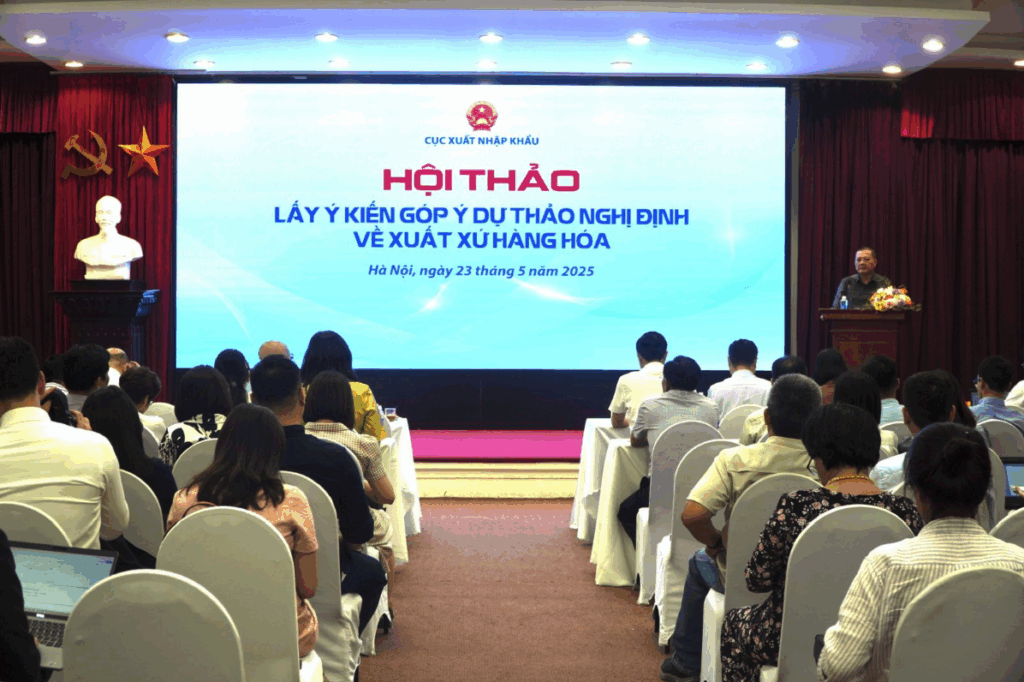
At the workshop “Collecting Comments on the Second Draft of the Decree on Goods Origin,” Mr. Nguyen Anh Son, Director General of the Import-Export Department, Ministry of Industry and Trade, said that on March 8, 2018, the Government issued Decree No. 31/2018/NĐ-CP detailing the Law on Foreign Trade Management with respect to goods origin.
To implement the provisions of Decree No. 31/2018/NĐ-CP in detail, the Minister of Industry and Trade and the Minister of Finance have issued legal documents guiding regulations on goods origin, origin inspection and verification, and the responsibilities of ministries, sectors and enterprises in export and import activities related to goods origin.
The introduction of Decree No. 31/2018/NĐ-CP has helped Vietnam complete its legal framework on goods origin, enabling traders to apply rules of origin to help boost exports and allowing Vietnamese goods to enjoy preferential tariffs, thereby expanding and penetrating international markets.
The implementation of Decree 31/2018/NĐ-CP has shown that its provisions have helped create a legal framework for state management of goods origin and have enabled traders to boost exports to markets covered by Free Trade Agreements.
To date, the Minister of Industry and Trade has issued 47 legal documents in the field of goods origin to guide procedures for issuing Certificates of Origin (C/O) and to implement rules of origin under the commitments Vietnam has entered into. Legal documents on goods origin have been incorporated into domestic law in compliance with the World Trade Organization’s (WTO) rules of origin regulations and origin commitments under Free Trade Agreements.
Since January 1, 2024, Vietnam has issued 13 forms of electronic C/O to enterprises, including: AANZ, AJ, E, AHK, RCEP, CPTPP, VJ, VC, VK, AK, D, VN-CU and S. For C/O form D and C/O forms AK and VK (to South Korea), Vietnam is transmitting electronic C/O data quickly and effectively. The issuance of electronic C/O has made a positive contribution to reducing costs and time for both enterprises and state agencies.
However, Mr. Son also frankly acknowledged that after seven years of implementing Decree No. 31/2018/NĐ-CP, participation in new-generation free trade agreements such as the CPTPP, EVFTA and UKVFTA, with their various different regulations and commitments, has given rise to a number of issues that this Decree needs to address, such as: the process and procedures for applying the self-certification of origin mechanism, sanctions for handling origin fraud, and certain issues related to C/O application dossiers, trader profiles, and record-keeping…
According to Mr. Son, international trade is currently developing in a complex and unpredictable manner, especially as the United States applies reciprocal tariff policies against many countries around the world, and trade fraud practices — including a growing trend of origin fraud — mean that developing a Decree to replace Decree No. 31/2018/NĐ-CP is necessary, urgent, and appropriate to the new circumstances.
In this regard, the Decree should aim to: complete the legal system on goods origin to make it more transparent, more comprehensive, and more consistent with the Commercial Law, the Law on Foreign Trade Management, and international commitments. Apply forms of origin certification that maximize convenience for exporting traders and enable risk-based management of imports, together with strict sanctions for origin fraud. Establish mechanisms to prevent and stop illegal transshipment and origin fraud aimed at enjoying preferential tariffs or evading the trade remedy measures of importing countries.
In addition, the Decree will update new content to serve as a basis for implementation in the coming years, providing a basis for enterprises and management agencies to determine the Vietnamese origin of imported and exported goods in order to enjoy preferential tariffs under the international treaties that Vietnam has signed or acceded to, in accordance with current law. The Decree also aims to strengthen efforts to prevent origin fraud and limit origin counterfeiting, and to protect the reputation and brand of Vietnamese export goods.
At the workshop, a representative of the Vietnam Timber and Forest Products Association shared a problem currently causing difficulties for the industry: under current regulations, plantation timber invested in and produced directly by enterprises does not require certification of the forest product declaration by commune-level local authorities or forest ranger agencies. However, the C/O application dossier required by the Ministry of Industry and Trade requires enterprises to provide a forest product declaration certified by commune-level local authorities and forest ranger agencies.
For this reason, the representative argued that the regulations of the Ministry of Industry and Trade are inconsistent with Circular 26 of the Ministry of Agriculture and Environment, causing difficulties for enterprises.
In addition, many foreign enterprises are currently investing in Vietnam to engage in wood processing for export in order to avoid high tariffs imposed by the United States. Under the regulation that exported wood products involving only simple assembly steps are not eligible for C/O, this is in practice very difficult to determine, since many products that undergo only a small amount of carving, planing or repainting may be considered products that have not undergone simple assembly.
Therefore, the Timber Association recommends that the drafting committee include an additional appendix in the Draft Decree, providing detailed regulations on what constitutes basic assembly for specific items or those at risk of being investigated for origin fraud, in order to make this clearer.